Executing bed bug thermal and contact eradication in Nashville, TN requires understanding the physical boundaries of high-density older homes and modern builds alike. In historic neighborhoods like Belmont-Hillsboro,…
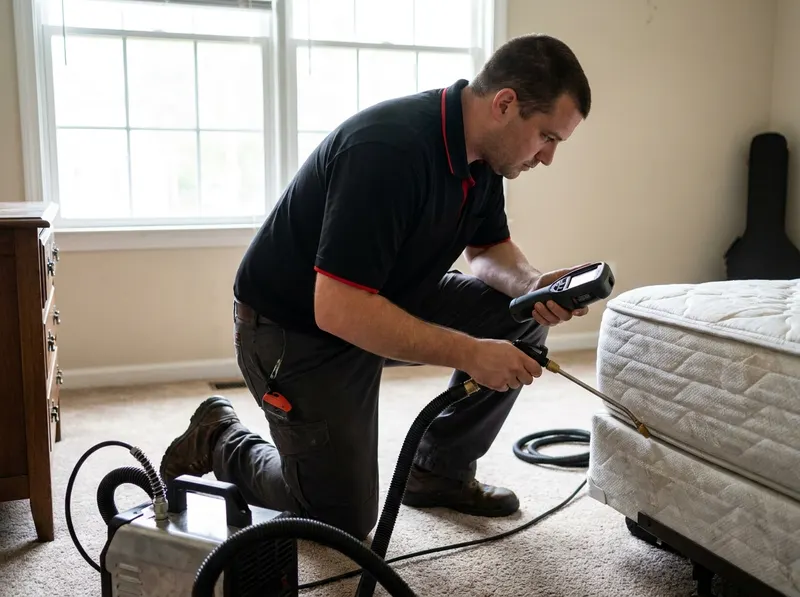
Executing bed bug thermal and contact eradication in Nashville, TN requires understanding the physical boundaries of high-density older homes and modern builds alike. In historic neighborhoods like Belmont-Hillsboro, Germantown, and East Nashville, lath-and-plaster walls and deep floorboard gaps provide migration routes into wall voids that aerosol sprays cannot penetrate. In contrast, slab-on-grade builds in Donelson, The Nations, and Antioch present tighter crawlspace dynamics where heat loss must be controlled. Heat treatments raise interior air temperatures to lethal thresholds established by the U.S. Environmental Protection Agency, while companion contact compounds target micro-harborages where temperatures rise more slowly. This integrated approach respects domestic safety standards set by the Centers for Disease Control and Prevention, protecting household occupants and pets from broad-spectrum overspray.
Thermal remediation functions by circulating forced hot air through industrial heaters until the thermal death point of 122°F (50°C) is maintained at structural cores for a minimum of 90 minutes, as verified through thermal sensors referenced by the Pest Control Technology technical guides. Contact eradication uses targeted, low-volatility applications along structural tack strips, bed frames, and electrical switch plates. Technicians calibrate treatments according to standards from the National Pest Management Association, ensuring compounds settle directly within harborages. For historic bungalows near Shelby Bottoms Greenway or modern townhomes in Green Hills, structural contents remain inside the treated thermal envelope, neutralizing pests nestled inside upholstered furniture without discarding personal property. Guidance from University of Tennessee Extension highlights how non-repellent formulations prevent bed bugs from scattering into neighboring multi-family walls or adjacent rooms.
Preparation involves concrete physical adjustments rather than chemical self-treatment. Residents remove heat-sensitive items, such as wax candles, vinyl records, aerosol cans, and prescription medications, prior to equipment deployment. CanyonWisp Pest Response provides an objective inspection to distinguish between localized introductions and established multi-room infestations. Equipment placement follows protocols verified by the National Institute of Standards and Technology for sensor accuracy and safety standards managed under Occupational Safety and Health Administration jobsite regulations. Exact pricing is confirmed on-site before heating units are staged, avoiding surprise surcharges. The standard protocol follows five structured operational phases:
Deciding between standalone thermal remediation and dual thermal-contact integration depends on structural contents and neighboring wall proximity. Standalone thermal remediation eliminates pesticide residues entirely, making it suitable for sensitive households, yet it lacks residual protection if external items reintroduce pests. Combining targeted contact barriers with thermal treatment resolves this vulnerability by maintaining a protective barrier on subflooring. Municipal housing parameters enforced by the Nashville Department of Codes and Building Safety govern structural modifications, while pesticide disposal and application compliance align with rules from the Tennessee Department of Agriculture and environmental standards monitored by the Tennessee Department of Environment and Conservation. CanyonWisp Pest Response completes treatments in single-day operations, avoiding open-ended service commitments. For scheduling or technical protocol inquiries, call (629) 319-7822.
Every job gets a firm, written price after an on-site visit.
Tell us about your bed bug thermal and contact eradication job in Nashville and we'll send a clear, written quote, usually the same day.
 CanyonWisp Pest Response