Flea and tick interior decontamination addresses parasite populations that bypass topical pet treatments and establish active nesting cycles within residential flooring and upholstery. In regions bordering humid…
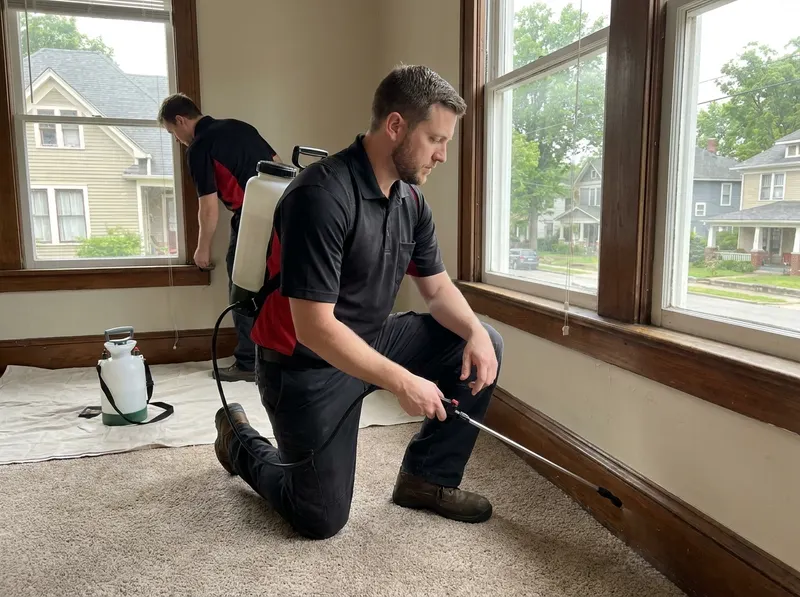
Flea and tick interior decontamination addresses parasite populations that bypass topical pet treatments and establish active nesting cycles within residential flooring and upholstery. In regions bordering humid outdoor habitats like Shelby Bottoms Greenway and Radnor Lake State Park, domestic dogs and cats readily introduce specimens such as the lone star tick into suburban dwellings. According to the Centers for Disease Control and Prevention, indoor tick drop-offs require systematic removal before secondary attachments occur. In East Nashville bungalows with original tongue-and-groove hardwood floors or Germantown lofts with thick area rugs, flea pupae settle deep within structural crevices. Standard consumer aerosol foggers fail to penetrate these depths and push pests into wall voids, whereas an engineered liquid barrier breaks the cycle at the sub-floor interface.
The trade-off between isolated spot treatments and whole-home decontamination centers on insect biology rather than current visual counts. While a localized flea issue might appear confined to a pet bed in a Sylvan Park cottage, flea larvae actively navigate up to 12 inches away from organic debris to spin protective silken cocoons. Data from the University of Kentucky Department of Entomology demonstrates that over 50 percent of an active home flea biomass consists of unseen eggs, while adult biting insects represent roughly 5 percent. Choosing a singular room spray leaves dormant pupae unaffected in adjacent hallways. Full interior decontamination pairs botanical-derived pyrethrins for immediate knockdown with synthetic growth modulators, which the United States Environmental Protection Agency classifies as low-risk formulations for domestic indoor use once dried.
Residential homes in Green Hills, Belmont-Hillsboro, and The Nations often present distinct flooring substrates that influence compound residual life. High-pile carpet matrices require fine-droplet penetration down to the jute backing, guided by standards outlined by the National Pest Management Association. Porous surfaces along floorboards in Inglewood or slab foundations in Donelson and Antioch demand precise volume calibration to avoid floor staining or excess ambient moisture. The Tennessee Department of Agriculture oversees strict compliance rules for structural indoor pesticide distribution, mandating clear re-entry timeframes. Decontamination protocols maintain safety boundaries by requiring a strict 2 to 4-hour evacuation window while carrier agents dissipate, protecting infants, pregnant individuals, and indoor felines from active wet residues.
Executing targeted remediation follows a disciplined mechanical and chemical progression to eliminate hidden larval clusters:
Exterior cross-contamination frequently challenges homes near wooded municipal boundaries. Wildlife vectors traveling along the Cumberland River corridor deposit adult parasites into perimeter turf. Technical management notes from the Occupational Safety and Health Administration govern safe handler application, while biological standards maintained by the Entomological Society of America verify that indoor treatments must be complemented by client laundering of all animal bedding at a minimum water temperature of 140 degrees Fahrenheit. The companion animal health parameters provided by the American Veterinary Medical Association urge simultaneous veterinary-approved animal treatments to prevent reinfestation of the newly decontaminated living envelope. For scheduling inquiries across Davidson County, call (629) 319-7822.
Every job gets a firm, written price after an on-site visit.
Tell us about your flea and tick interior decontamination job in Nashville and we'll send a clear, written quote, usually the same day.
 CanyonWisp Pest Response